Barthes’ method for deconstructing a text is described “in the cinematographic sense” (12) implying the dynamic, visual practice of such a decomposition. With slow motion, in a step-by-step practice, Barthes seeks the renewal of multiple entrances into the text (called stars). These stars systematically digress and reverse the structure, code, or order of writing by highlighting specific units of reading or blocks of signification, also known as lexias. Barthes’ method is poststructuralist in its rethinking of subjectivity and the space of a text. It allows the text to be plural and denies the naturalness that glosses the classic text with its single origin of meaning. This method is focused on the play with codes that structure text.
The passage to be broken down is the third passage from Stuart Moulthrop’s essay “You Say You Want A Revolution? Hypertext And The Laws Of Media.”
The title is fitting for this essay because it explores the subjectivity, freedom, and control within hypertext. It calls for the rethinking of the space that we experience and live within. Although The Beatles were singing to the revolutionary sixties-youth generation, in the context of hypertext Moulthrop is calling for a similar radical or oppositional action that will transform the space of hypertext.
The passage is of interest because it discusses the ideological consequences of complicity with hyperreality.
Those ideological consequences stem from the connotation of complicity: collusion or involvement with something, often in relation to an illegal activity. This connotation is in fact a reversal of how society views technology because it highlights a conscious relationship with technology. In reality technology is transparent and we are unconscious to our relationship with it. Moulthrop is questioning our shady involvement to bring forth a more conscious knowledge of how technologies work upon us.
In order to break down and open up this concern in the text, I will enter the text through the word “patina.”
Barthes method into the text is through connotation, otherwise known as the namable trace of a certain plural of the text. Since all actions are culturally coded, I found it fitting to use a personal trace I found in the text that relates to my own experience with the text.
“Patina” is found in the line: “A patina of thought, of signifiers, of ‘connections,’ now lies on everything the mind touches in its Gnostic(noo)sphere…”. I chose this entry point because while reading the text the word patina referenced Frederic Jameson’s comments on Andy Warhol’s painting “Diamond Dust Shoes.” From this personal nodal point, I will seek to open up a “stereographic space” for the passage to exist within.
Stereographic space described by Barthes is a space where the origin of a text has been lost within the already written and the codes of writing converge. For a hypertext, stereographic space is the convergence of visual and cultural reference points from the text, as this blog entry attempts to display.
THESIS: Although Moulthrop sees ideological consequences with our complicity with technology, I will work to prove that our complicity allows for creativity within the system. To prove this point, I will use Barthes’ step-by-step method of starring a text. This method breaks down Moulthrop’s third passage in order to explore and expose the hypertextuality of text and the possibilities such a structure has when one plays within the system.

My analysis will work on two levels: the meta-textual (looking back onto my method of analysis in relation to classic essay form) and the hypertextual (the substance and examples to support my analysis through the blog form). The above introduction is in a broke down textual essay form. The course of the essay will follow passage 3 of Moulthrop’s essay. The next section is the work to prove my thesis using references, Barthes, and Moulthrop, however I will use hypertext as opposed to textual essay form. The conclusion to my essay is both a closing and opening due to the complex nature of hypertext.
Disclaimer: I must take a moment here to discuss my relationship to technology. Complicity with technology is undone when the user fails. In this text, the moments where the technology fails displays my own limitations within the structure of the blog. My personal interest in the patina of thought within Moulthrop's passage comes from this idea that my relation to and use of technology is itself worn down by my own inability. Patina allows for a coherent unity with the code of technology because I can explore the issues of surface, duration, and materiality within technology. Below I explore these technological and cultural patins that I found in Moulthrop's text.
My work of starring must begin by discussing the immanence and innocence of text in both Barthes and Moulthrop. Moulthrop quotes Ihab Hassan: “ 'immanence' or the intertextuality of all life. A patina of thought, of signifiers, of ‘connections,’ now lies on everything the mind touches in its Gnostic(noo)sphere…”(172). This quote comes from his book “ The Postmodern Turn: Essays in Postmodern Theory and Culture.” Hassan, an Egyptian literary theorist, is bringing forth the crucial issue with text and hypertextuality: the innocent nature of the inherent correlations within text. For Barthes, intertextuality is connotation – both the starting point of code and the point where the plurality of the text can be released. For Moulthrop, in hypertext this immanence is the all-encompassing engagement the user has with technology based upon technologies functionality and usefulness. The relationship between technology and user awards the innocent or neutral gloss to technology. This gloss is also a way to interrupt that mythical belief. A user's every action is coded by it the structures of technology, but the user operates within the text. If the user plays with the code, as if in a game, then the structure starts to reverse itself. Our complicity with the code allows for this play.

Patina is the visible structure of the code and hypertext is the code beneath that gloss. I have an image of my notes structuring this essay because these are the hypertext of my thoughts, glossed over by the textual essay form of this blog entry.
Intertextual connections are at the same time everywhere and nowhere.

Looking at Jameson’s analysis of Andy Warhol’s painting, “Diamond Dust Shoes,” delves into what the patina of a medium does to the observer or user of the code. Although this example is in the realm of visual art it brings forth the issue of viewership with hypertext and the materiality of technologies interface. Jameson is discussing the death of the object world in the postmodern era since Warhol’s "Diamond Dust Shoes" have the deathly quality of commodity fetishism in late capitalism. The diamond dust or patina produces an image that can be only read as a set of texts or simulacra. The shoes have no originals and the Diamond Dust shimmers over this deathly substratum of Warhol’s photographic image.
 Nature has been lost and as viewers we replace it with an attractive decorative gloss. Warhol’s shoes are a set of dead objects, a set of texts used to produce a spatio-temporal position for us as viewers. As postmodern viewers we comply with the gloss of the interface because the reality behind it cannot be imagined or we do not wish to imagine it.

This reading has brought up three important places to explore within Moulthrop’s piece in relation to complicity: how the patina or gloss of the interface structures codes that makes up technology (if this is true, then how is our interaction with technology coded?), the fact that all units of meaning are simulacra (what is meaning?), and the empty or deadness’ of these structures that highlight our fears of complying with technology.
 The postmodern condition calls for us to play within the system.
The naturalizing gloss over technology must be “manhandled” or interrupted as Barthes describes in order to find the plurality of a text. As users or readers we must play with the shifting and repeating signifiers of the text in order to reveal and reverse the structure of code. The debate on media art is interesting to look at in relation to the diamond dust of technology. One side defines media art as the creation of new codes or severe manipulation of existing codes that reveal the glossed over hypertext. For example the Whitney Biennial Exhibit “CODeDoc” from 2002 is described as a “reverse look at ‘software art.’” On the other side is the “remix” generation that finds abstracting and reorganizing already existing codes as media art. For example the debated work of mash-up musicians, seen on blogs and sites such as www.bootiesf.com. This debate questions the status of using versus creating code in order to critique the system. Here lies the question of originality in the system. For Barthes, any denial of naturalness or interruption of the system is the work of starring a text. What we must question now is Michael Heim’s point: “[in]magnetic code there are no originals.”
The meaning we gather from text is simulacra. Postmodern space Hassan describes as the “Gnostic(noo)sphere” (or in other words an esoteric space of nothingness) that meaning disseminates from. As Moulthrop says technology can quickly transmit, duplicate, and assemble new knowledge structures from these simulacra. Although the structure may be new, it is not original. We experience nostalgia for the past in our current reality. This nostalgia is powerful and lets interfaces gloss over the code that defines them. The immediacy of knowledge transmits non-original, empty meaning that we believe as reality. Moulthrop calls this the “infinitely convoluted system of discourse.”
Looking at the music video “Star Guitar” by musician Shinichi Osawa explores the creation of new knowledge structures from duplicates and the viewer’s experience receiving those new, remixed images. Musically, Osawa is remixing two other artists, Au Revior Simone and The Chemical Brothers, with electronic music technology. Visually, the video displays infinitely multiple and duplicating images that follow the beat of the music. Every element has been abstracted and remixed from other originals. Our viewing experience is lost within the structure of this cinematic, all-encompassing, coded space.
Moulthrop finds this experience with technology critically depressing because of the confusing space of subjectivity and individuality within the system where we are complicit with technology. Moulthrop worries that as users we will become servants to the machine, hopelessly abandoned to simulation.

It is the anxiety that Jameson discusses in relation to the death quality of objects in Warhol’s “Diamond Dust Shoes.” The idea that all meaning, interaction, and knowledge is from an empty mirror, only ever looking back at the viewer. It is the danger of never finding our individuality again, but only the simulacra of our subjectivity.
This point is shown in the video “The Machine is Using Us.” This video displays all that has been discussed above: the play within the system allowed by and limited by our compliancy with technology. This video hits at our ability to be creative and play within technology as it repeatedly points to the places within normal interactions on the web users are able to view the framework behind the interface. The play with hypertextual writing within various well-known interfaces accompanied by electronic music signifies a progression or journey through the complexity of the web. However, it is a journey we are able to take if we play technologies game. The title however breaks this feeling of the power within the web by bringing the viewer back to his or her fear that in fact these possibilities are using us since we are users of them. Such a reversal between viewing experience and connotation of the machine describes Moulthrop’s anxieties and fear of our complicity.
Moulthrop’s reference to Baudrillard opens up the stereographic space to bring the text back together with its opening argument on complicity. Quoting Baudrillard brings to mind simulacra, simulation, and counterfeits. These references refer to the core of the ideological consequences with complicity: the fact that all has become simulacra. Baudrillard’s quote, from Simulation, describes the totalizing space of technology, illuminated and dynamic, where Moulthrop understands the postmodern user to be lost. Baudrillard’s cites the theater to explore the possibility of this totalizing space as a space for users to play with technology. Just as Barthes writes about the best possible space to observe the multiple meanings of the text, Baudrillard is calling for a stereographic space.
Interestingly Moulthrop connects back to literature at the end of passage 3 by referencing a famous Shakespearian quote from the play As You Like It Act 2, scene 7, 139-143. By referencing literature, Moulthrop is citing the literary theory of a single text. However, the plurality of that quote comes forth from Barthes method.
The actual quote is:
And all the men and women merely players;
They have their exits and their entrances,
And one man in his time plays many parts…”
While Moulthrop flips this classic text into hyperreality with his version: “If all the world’s a simulation, then we are but simulacral subjects cycling through our various iterations, incapable of any “radical” or “oppositional” action that would transform the techno-social matrix.” Moulthrop is critical of complicity with technology and so his call back to literature appears a nostalgic move towards the innocence of reading. In that harking back, Moulthrop creates just the stereographic space where users become actors, acting out various roles within a complex space defined by a code or language game. Yet the idea that as users we are nothing, but simulacra ourselves is what worries Moulthrop about this stereographic space.

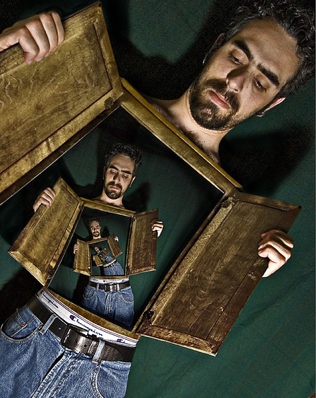
This worry brought me back to a photographic project I did a few years ago referencing Cindy Sherman’s “Untitled Film Stills” series. This project was my first attempt at self-portraiture and became a project of making myself into simulacra. Cindy Sherman’s work depects film stills without an actual origin movie. My acting out of her acting out is an example of the “precession of simulacra” that Baudrillard believed defined our modern age. Barthes would argue it reveals that “the code is a perspective of quotations” (20). The work of systematically digressing the reading of my project brings forth the code that structures the form of my own subjectivity.
GREAT RISKS – DEATH, EMPTINESS
MEANING IN POSTMODERNITY – SIMULACRA
POSSIBILITY: EXPERIENCE WITH WORLD
I would like to end this exploration into hypertextuality and the ideological consequences of complicity with technology with the idea of subjectivity based on affinity. Our subjectivity may no longer be secured because it is in constant movement. Barthes called for this movement and play in order to get at the plurality of texts. The technology constrains us within its code, but leaves us free to play within that structure. The creation of knowledge and creativity has not been lost to the code, but as users we reveal that those very things are coded by the structure. As much as we use the machine, the machine uses us, and so we cycle through the system. Moulthrop's third passage opens with the question it closes with - the problem of simulacra. As a passage within an essay, Barthes method of reading has explored the circulation and repetition of this signifier in the text. As with our experience in the world where work never comes to an end, this ending leaves off with space for further questions or interpretation, but I will close it here.






No comments:
Post a Comment